Lead Designer
Led the end-to-end redesign of the Martha Stewart Living homepage, navigating high-visibility stakeholder complexity and deep editorial oversight to modernize a legacy brand's digital presence without losing what made it iconic.
Overview
Role: Lead Designer Focus: Consumer-facing redesign, legacy brand modernization, editorial stakeholder alignment
Few consumer brands carry the weight of expectation that Martha Stewart Living does. The brand has a decades-long editorial identity, one with a deeply loyal audience, a highly involved editorial team, and executive stakeholders with strong, informed opinions about what the brand should and shouldn't be. Redesigning the homepage meant working within all of that, not around it.
I led this project as the primary UX and visual designer, responsible for the full arc from discovery through final presentation. The challenge wasn't just design, but it was earning trust from a team that cared deeply about every decision, and delivering something that could satisfy both the rigors of UX best practice and the aesthetic standards of a design-forward legacy brand.
Problem
The Martha Stewart Living homepage had fallen behind its own brand. The editorial team had continued evolving the magazine's visual identity, sharper, more intentional, with a cleaner hierarchy and stronger sense of curation; but the digital experience hadn't kept pace. The homepage felt dated relative to the print product, and its content structure no longer reflected the brand's editorial priorities.
At the same time, this wasn't a straightforward modernization job. Martha Stewart Living operates with a level of brand scrutiny that most digital products don't face. Every layout decision, every typographic choice, every content module carries implicit brand meaning. The risk of getting it wrong, and producing something that felt generic, or that diluted the brand's distinctive aesthetic was taken seriously by everyone in the room.
The design brief, then, was narrow in the best way: make it modern, make it content-forward, make it unmistakably Martha Stewart Living.
Discovery & Stakeholder Alignment
With limited quantitative data available at the start of the project, I built the discovery phase around qualitative insight and specifically around the people who knew this brand most deeply: the editorial team.
I facilitated a series of working sessions with editors, bringing them into the design process early rather than presenting to them later. These weren't passive briefings. I structured the sessions to surface concrete priorities: which content needed to be visible above the fold, which modules were non-negotiable expressions of brand identity, where the current homepage was failing their editorial strategy, and what success would look like from their perspective.
This approach served two purposes. Practically, it gave me better inputs than any analytics dashboard could have. Editors carry institutional knowledge about what resonates with the Martha Stewart audience that takes years to accumulate. Strategically, it meant that when I brought design concepts for review, I wasn't presenting to skeptics. I was presenting back a version of what the team had helped define.
Those early sessions also revealed something important about how to navigate this particular stakeholder environment: editorial teams at legacy brands aren't resistant to change, they're resistant to change that doesn't respect what the brand has earned. The more clearly I could connect a design decision back to an editorial value they'd expressed, the more productively the conversation moved.
Design Process
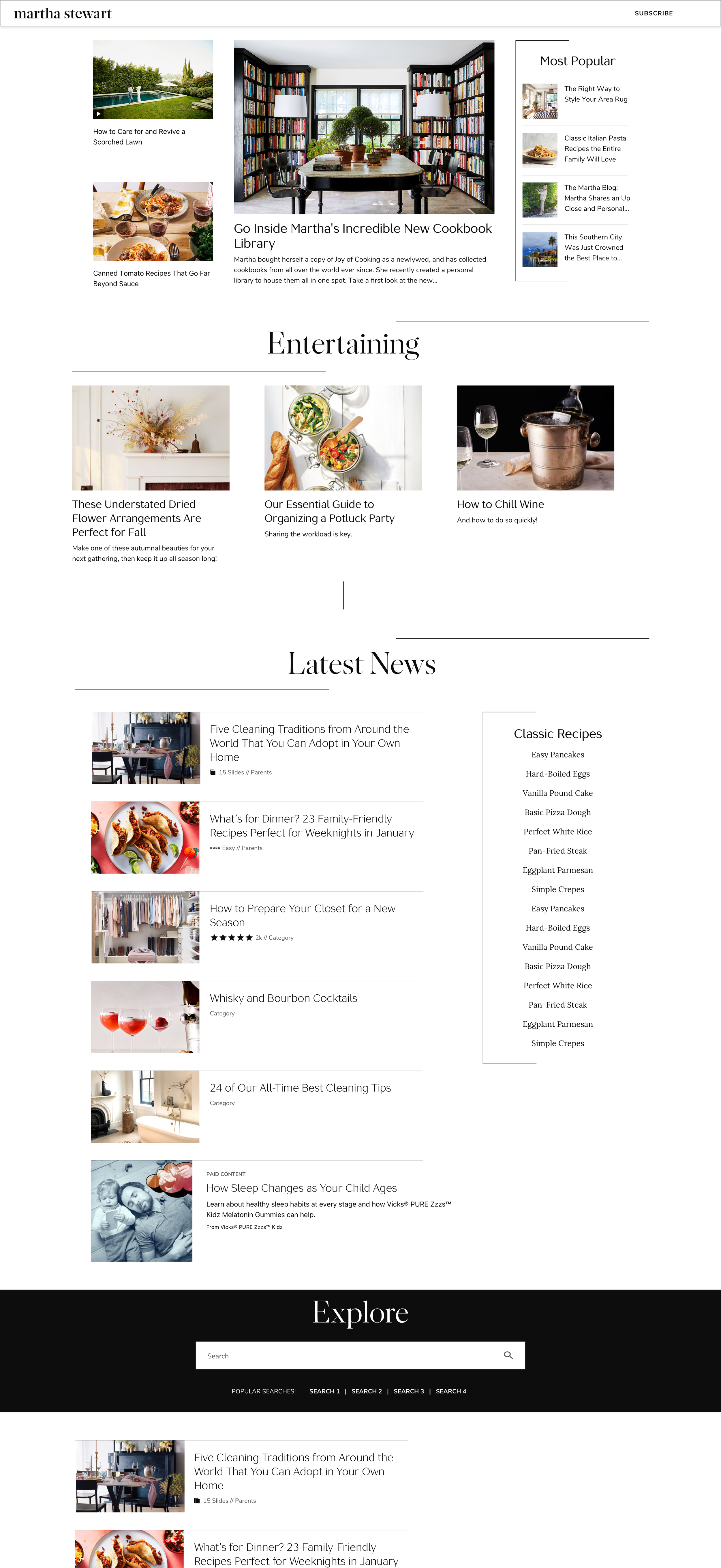
I developed multiple homepage concepts in parallel, each exploring a different approach to the core tension in the brief: how do you modernize a legacy brand without making it feel generic?
Each concept addressed the same set of structural questions: content hierarchy, module flexibility, visual rhythm, typography, but answered them differently. Some pushed harder toward a cleaner, more minimal aesthetic; others preserved more of the brand's layered, editorial richness. Presenting them as a set, rather than a single recommendation, was deliberate: it gave stakeholders a framework for articulating what they valued, which made the feedback more useful than simple approval or rejection.
Over multiple rounds of iteration, the direction refined. I incorporated feedback from editorial, product, and the VP of Design at each stage, not by treating every note as an equal directive, but by synthesizing the feedback into design decisions that served both user experience and brand integrity. When those two things came into tension, I made the tradeoff explicit rather than splitting the difference quietly.
The iterative loop also served a relationship function. Stakeholders who feel genuinely heard through a process are more likely to trust the final recommendation, even when the final design doesn't reflect every preference they expressed along the way. Building that trust was as much a part of my job on this project as building the design itself.
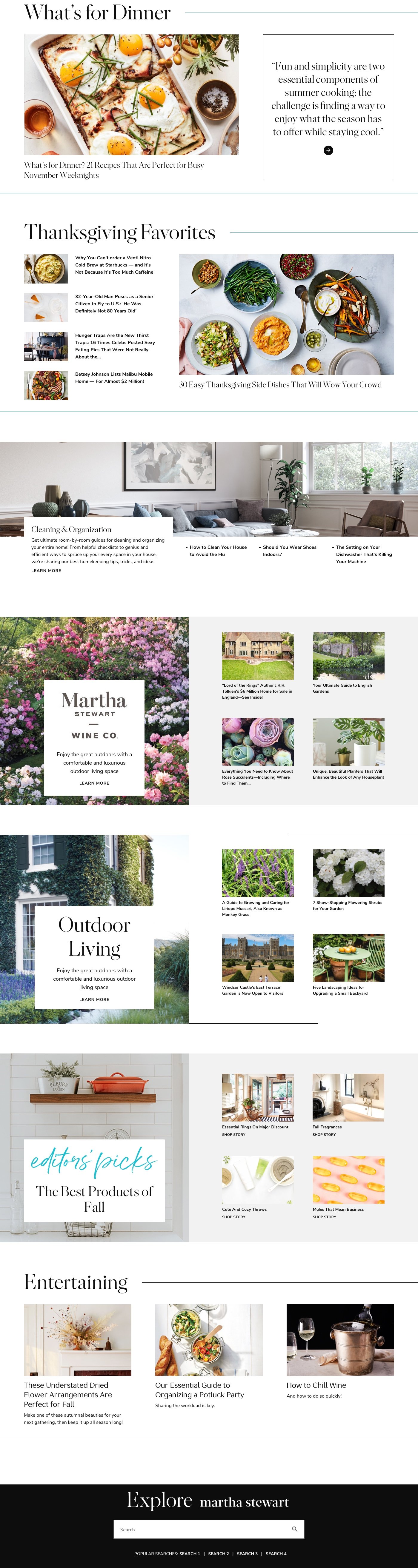
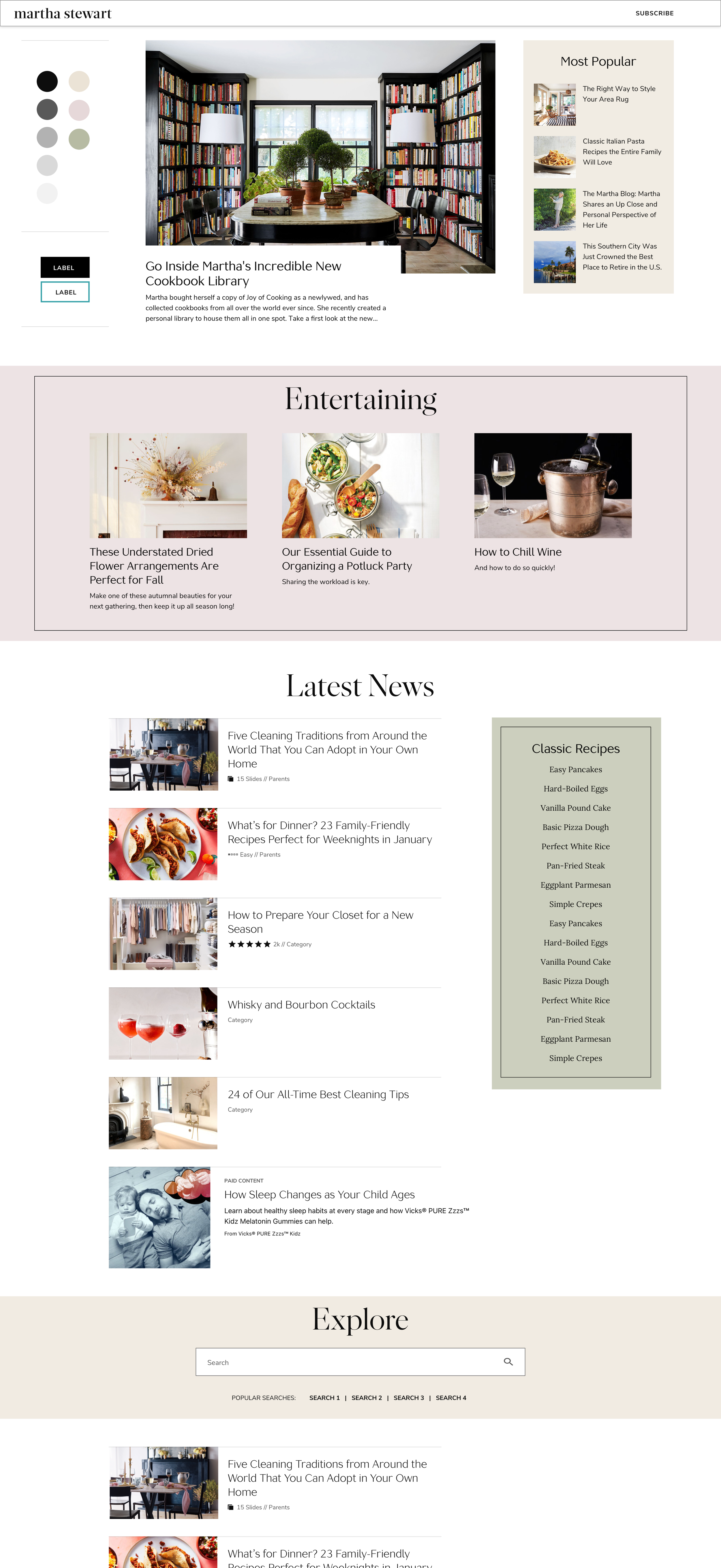
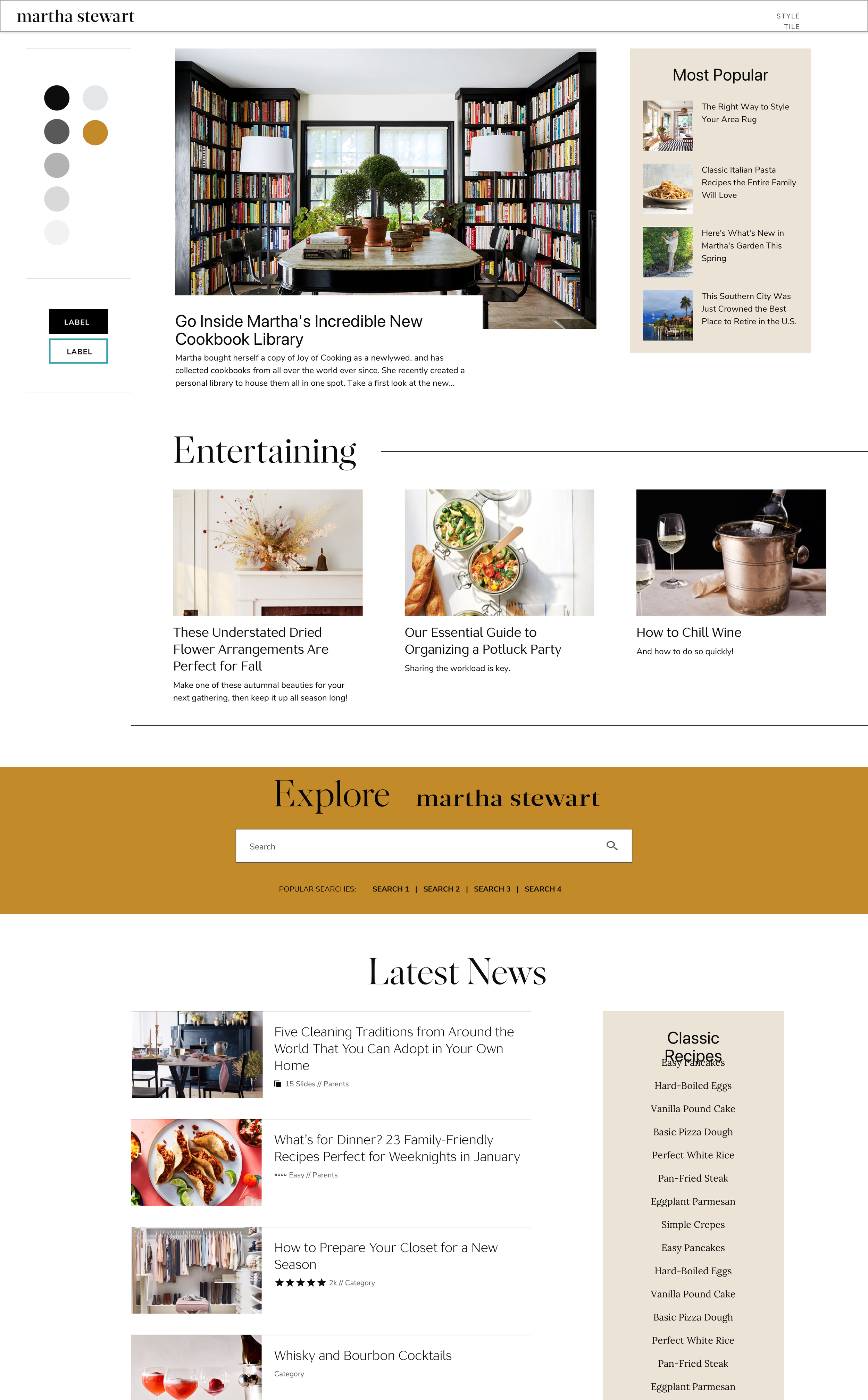
Here, I explored various content block designs & applications of brand color & typography.
Before landing on a final direction, I ran multiple rounds of exploration focused on translating Martha Stewart's print brand equity into a digital-first experience. I audited the magazine's existing brand elements, color palettes, typographic treatments, editorial layout conventions and tested how faithfully (or not) they could carry over to a responsive homepage without losing their warmth or editorial authority.
Each round pushed further into color application and type pairing, weighing legibility and digital usability against brand recognition. In parallel, I stress-tested every direction across four breakpoints to ensure the hierarchy, imagery, and typographic scale held up from mobile through desktop, rather than designing desktop-first and retrofitting down.
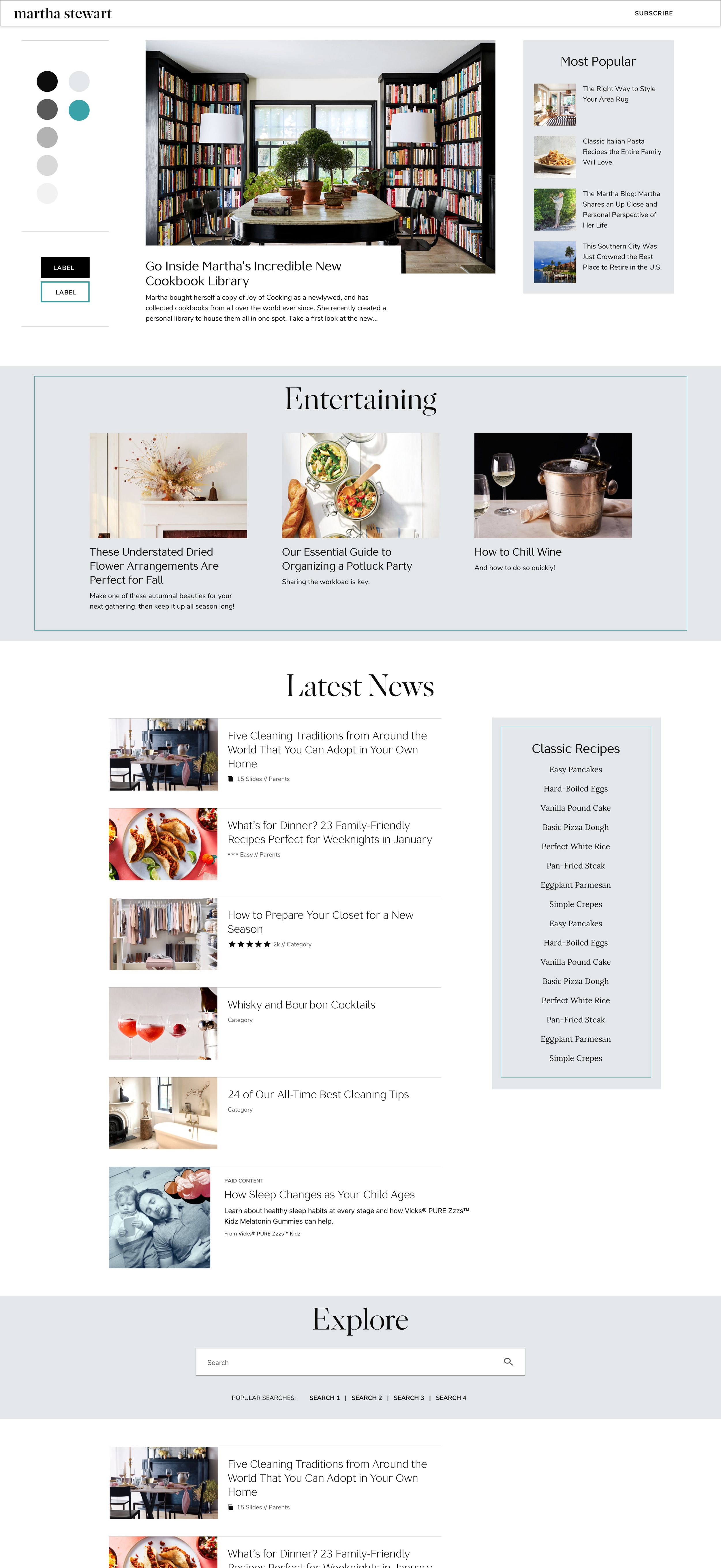
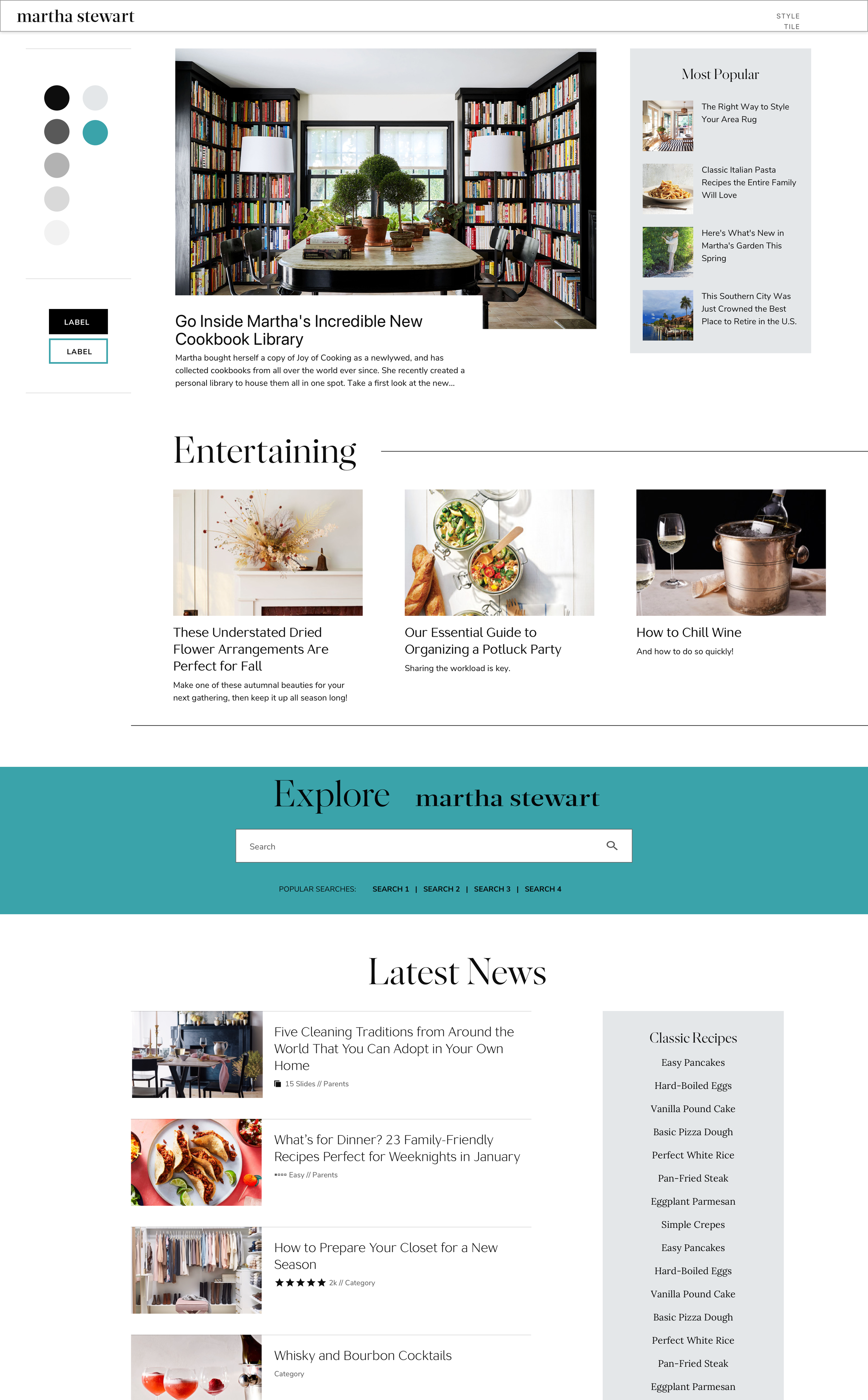
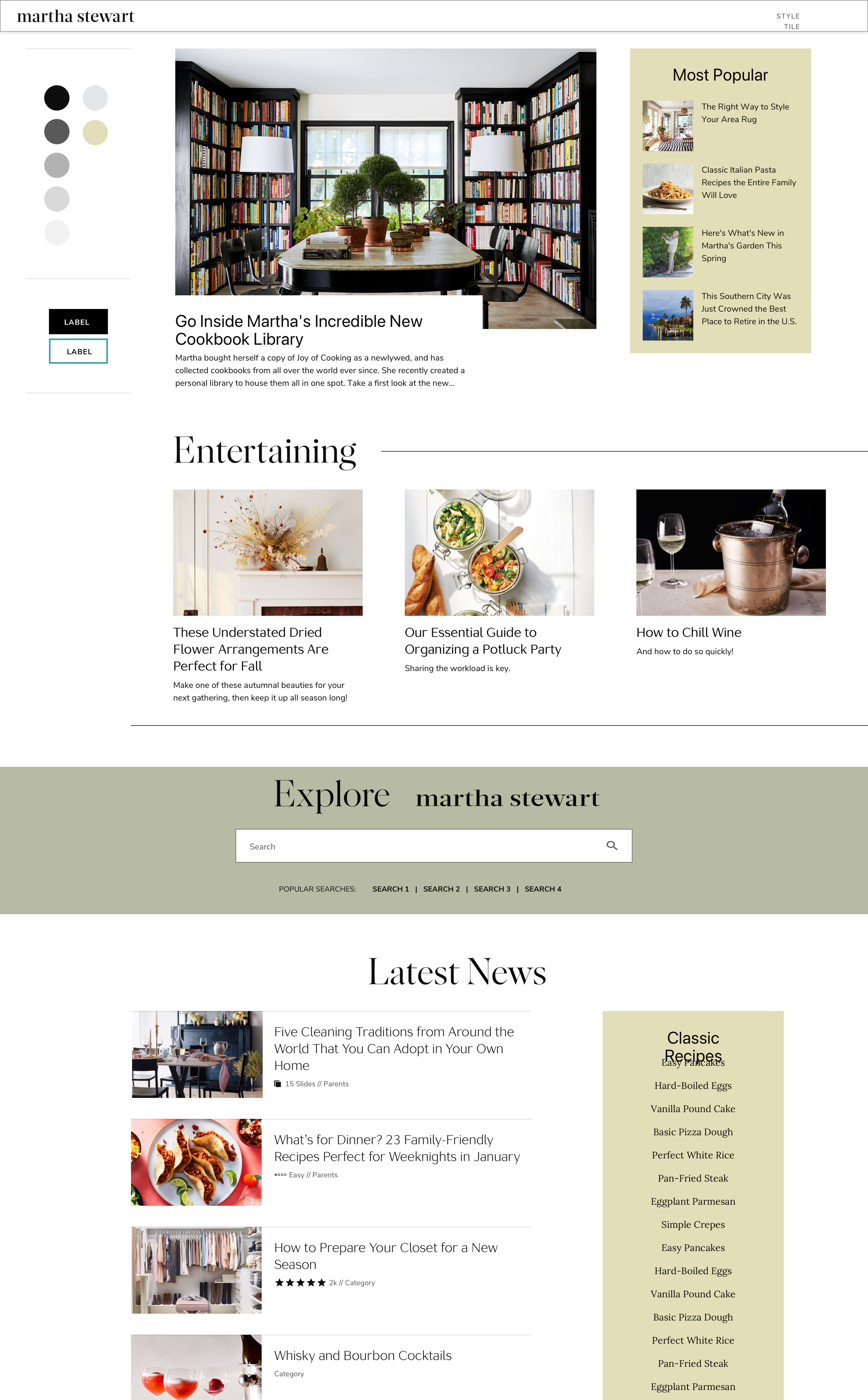

Here, I explored various content block designs & applications of brand color & typography and how it would translate to mobile.
Solution
The final homepage redesign delivered a content-forward experience with a cleaner visual hierarchy, a stronger typographic system, and a modular layout structure that gave the editorial team more flexibility to feature content according to their priorities (seasonal moments, feature franchises), without requiring custom design work each time.
Key design decisions included:
Content hierarchy: Restructured the above-the-fold experience to lead with editorial intent rather than promotional content, reflecting how the Martha Stewart audience actually engages with the brand.
Typographic system: Refined the type hierarchy to more closely reflect the print magazine's editorial voice as authoritative, considered, with clear distinction between headline, supporting, and utility text.
Modular layout flexibility: Designed the homepage around a set of reusable content modules that could be assembled in different configurations, giving the editorial team meaningful control over the page without requiring one-off design solutions.
Visual restraint: Made deliberate choices about what not to add and resisted the impulse to fill space, introduce new brand elements, or optimize aggressively for engagement at the expense of editorial tone. For a brand like Martha Stewart Living, knowing what to leave out is as important as knowing what to put in.
Impact
Delivered a homepage redesign that was received with strong approval from the VP of Design; specifically noted for successfully balancing editorial brand standards with UX best practices, a bar that is particularly high at MSL
Established a content module system that gave the editorial team greater flexibility and reduced reliance on custom design for seasonal and campaign moments
Strengthened the visual alignment between the digital homepage and the print magazine's current editorial identity
Built a cross-functional alignment process that became a reference for how to approach high-scrutiny brand redesigns within Meredith's portfolio
Reflection
This project taught me that at certain kinds of companies, ones where brand identity is the product, where editorial voice is the competitive advantage, the design process is inseparable from the relationship work. You can't separate them and do either one well.
It also pushed me to get more precise about a skill I'd been developing throughout my time at Meredith: translating between the language of editorial and the language of UX. Editors think in terms of voice, curation, and reader relationship. Designers think in terms of hierarchy, pattern, and system. Both are right. The designer who can move fluently between those two registers, who can hear an editorial concern and translate it into a design decision, or explain a UX tradeoff in terms of what it means for the reader experience is a much more effective collaborator at a media company than one who can't.
That's a skill I've carried forward deliberately, and one I think matters more in media and publishing than almost anywhere else.

